
Catalyst
Social
May 17, 2026
Why Great Travel Programs Still Have Gaps

Jeff Berk
CEO, TRIPKICKS
Catalyst
Social
May 17, 2026
Why Great Travel Programs Still Have Gaps
Jeff Berk
CEO, TRIPKICKS
Catalyst
Social
May 17, 2026
Why Great Travel Programs Still Have Gaps
Jeff Berk
CEO, TRIPKICKS
Every travel program has ambitious goals: cost control, compliance, sustainability, traveler experience. And the vast majority of programs are well-designed. The policies are clear. The preferred suppliers are negotiated. The rate caps are in place.
So why do gaps still exist between what programs are designed to achieve and what travelers actually experience?
The answer isn't that programs are poorly designed — they're not. And it's not that most travelers are being difficult. The answer is structural: the systems available to most programs weren't built to close this gap at scale.
The delivery challenge
Travel managers are some of the most versatile people in any organization. Their roles have expanded significantly — 68% have taken on travel sourcing as a core responsibility, 51% now manage payment programs, and 56% are responsible for sustainability initiatives, according to GBTA. They're expected to architect the program, communicate with travelers, analyze results, manage suppliers, and respond to whatever global disruption arrives next.
With that reality, consider what it takes to effectively communicate a single program initiative. Take preferred hotel compliance as an example. The travel manager needs to define the messaging approach, write the copy, design the communication, determine who should receive what message and when, build the delivery mechanism, send it, and then track whether it worked. That's five to six discrete steps for one initiative. Most programs have a backlog of ten or twenty things they want to address.
The programs themselves are sound. The challenge is that execution depends almost entirely on the travel manager's personal bandwidth — and 47% report their role is more stressful than it was just two years ago.
Why travelers don't always follow through
When there are gaps in traveler compliance, it's usually about information delivery rather than intention. Sometimes it is willful — travelers want to do what they want — but more often it's structural. Travelers genuinely don't have the information they need, when they need it, in a form they can act on.
A GBTA study published in March 2026 found that 32% of employees don't comply with travel policies simply because they haven't read or aren't familiar with the rules. A separate BTN study found that 28% of travelers say they don't know which hotels are preferred at their destination.
Three patterns show up consistently. First, timing: guidance arrives during onboarding (months before a trip) or in post-trip reports (after the booking is complete). Neither window is useful for the traveler who is about to make a decision. Second, relevance: generic communication sent to everyone regardless of whether it applies to their situation — the international travel reminder to someone who has never traveled internationally, the preferred hotel reminder for a city where there are no preferred hotels. Travelers tune it out, and then tune out everything else too. Third, channel: information lives in portals nobody visits, policies nobody reads, and training that happened once and faded.
None of these are failures of program design. They're failures of delivery systems — structural limitations that travel managers have had to work around because the tools available simply weren't built for this.
The cost of reactive enforcement
Most programs rely on post-trip reporting as the primary compliance mechanism — but that reporting often isn't directed at the actual traveler. The data goes into dashboards and summary reports. The travel manager sees trends. They might follow up with a department or a manager. But the traveler who made the out-of-policy booking two weeks ago has moved on. The booking is done. The trip is over.
This reactive approach also consumes real bandwidth. Every hour spent chasing a booking that already happened is an hour not spent improving program design or tackling the next initiative in the backlog. And it positions the travel manager as an enforcer rather than an advisor — which is the opposite of how most travel managers want to be seen.
Closing the gap
Closing the gap between program design and traveler experience requires the right information at the right time. But here's what's important to understand: a strong travel program isn't built on compliance reminders alone. It's built on making sure travelers have what they need to be successful — preferred supplier information, destination-specific details, safety considerations, expense guidance, and yes, policy reminders when relevant.
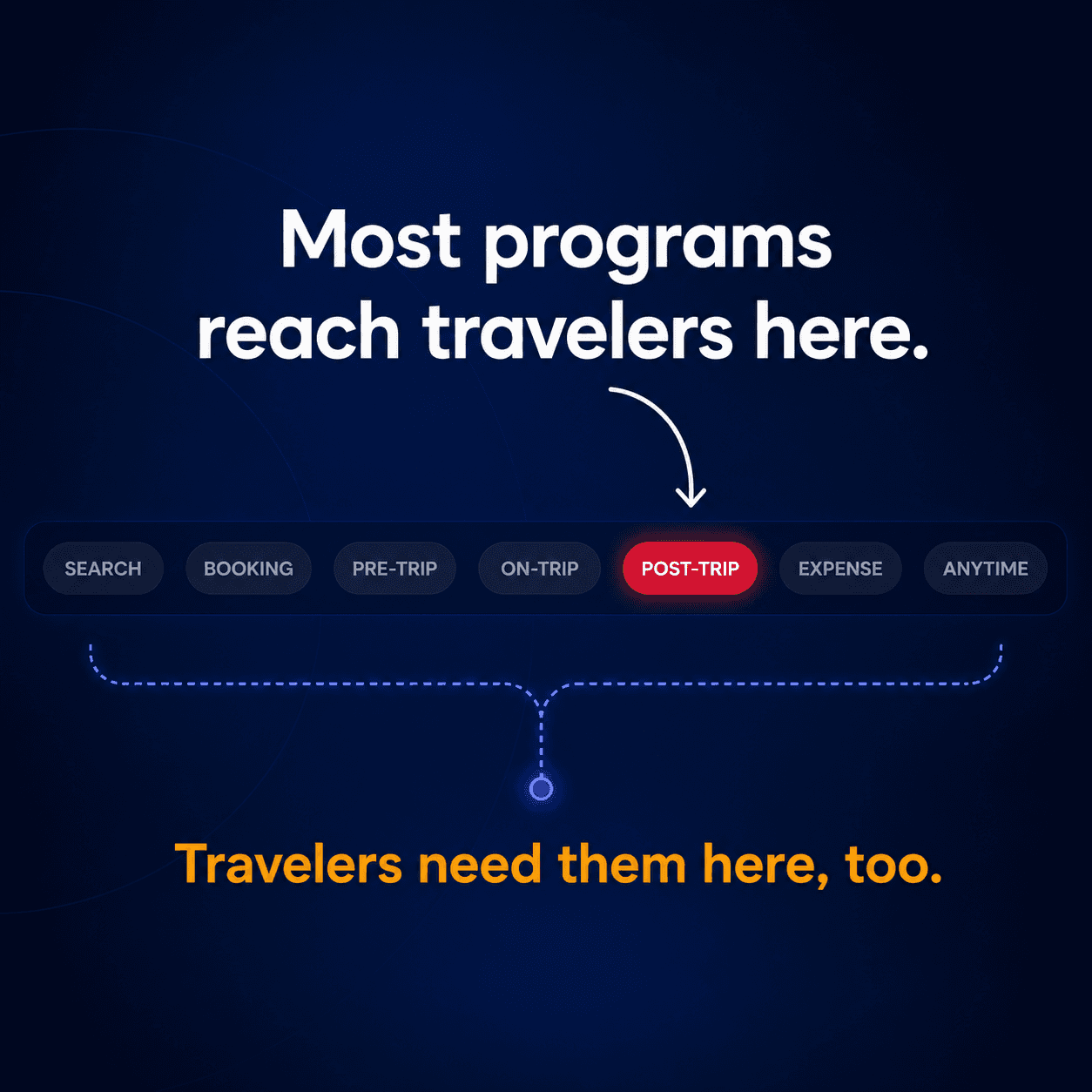
So when does all of this information — both compliance guidance and practical trip support — actually reach travelers? The biggest opportunities aren't limited to one moment. They span the entire trip journey. At booking, contextual guidance helps travelers make decisions aligned with the program. Pre-trip, practical information about the destination, transportation, and documentation helps travelers arrive prepared. During the trip, safety updates or logistical information can be critical. Post-trip, reinforcement of what went well helps travelers build better habits.
Reaching travelers at these moments with guidance that's relevant to their specific situation — not a generic banner shown to everyone, not a policy document distributed once, but contextual, personalized, timely communication — is what actually closes the gap.
A new standard
The gap in most travel programs isn't design. It's delivery. Travel managers have been building excellent programs for years. What's been missing is the ability to execute their strategy at scale across every traveler, every trip, and every touchpoint — without adding to their already full plates.
The future of travel program management is proactive. The programs that close the gap between design and experience — by reaching travelers across the entire journey with personalized, contextual guidance — will outperform the ones still relying on post-trip reports and one-size-fits-all communications.
That gap has been accepted as normal for too long. It doesn't have to be. That's why we built Catalyst.
Every travel program has ambitious goals: cost control, compliance, sustainability, traveler experience. And the vast majority of programs are well-designed. The policies are clear. The preferred suppliers are negotiated. The rate caps are in place.
So why do gaps still exist between what programs are designed to achieve and what travelers actually experience?
The answer isn't that programs are poorly designed — they're not. And it's not that most travelers are being difficult. The answer is structural: the systems available to most programs weren't built to close this gap at scale.
The delivery challenge
Travel managers are some of the most versatile people in any organization. Their roles have expanded significantly — 68% have taken on travel sourcing as a core responsibility, 51% now manage payment programs, and 56% are responsible for sustainability initiatives, according to GBTA. They're expected to architect the program, communicate with travelers, analyze results, manage suppliers, and respond to whatever global disruption arrives next.
With that reality, consider what it takes to effectively communicate a single program initiative. Take preferred hotel compliance as an example. The travel manager needs to define the messaging approach, write the copy, design the communication, determine who should receive what message and when, build the delivery mechanism, send it, and then track whether it worked. That's five to six discrete steps for one initiative. Most programs have a backlog of ten or twenty things they want to address.
The programs themselves are sound. The challenge is that execution depends almost entirely on the travel manager's personal bandwidth — and 47% report their role is more stressful than it was just two years ago.
Why travelers don't always follow through
When there are gaps in traveler compliance, it's usually about information delivery rather than intention. Sometimes it is willful — travelers want to do what they want — but more often it's structural. Travelers genuinely don't have the information they need, when they need it, in a form they can act on.
A GBTA study published in March 2026 found that 32% of employees don't comply with travel policies simply because they haven't read or aren't familiar with the rules. A separate BTN study found that 28% of travelers say they don't know which hotels are preferred at their destination.
Three patterns show up consistently. First, timing: guidance arrives during onboarding (months before a trip) or in post-trip reports (after the booking is complete). Neither window is useful for the traveler who is about to make a decision. Second, relevance: generic communication sent to everyone regardless of whether it applies to their situation — the international travel reminder to someone who has never traveled internationally, the preferred hotel reminder for a city where there are no preferred hotels. Travelers tune it out, and then tune out everything else too. Third, channel: information lives in portals nobody visits, policies nobody reads, and training that happened once and faded.
None of these are failures of program design. They're failures of delivery systems — structural limitations that travel managers have had to work around because the tools available simply weren't built for this.
The cost of reactive enforcement
Most programs rely on post-trip reporting as the primary compliance mechanism — but that reporting often isn't directed at the actual traveler. The data goes into dashboards and summary reports. The travel manager sees trends. They might follow up with a department or a manager. But the traveler who made the out-of-policy booking two weeks ago has moved on. The booking is done. The trip is over.
This reactive approach also consumes real bandwidth. Every hour spent chasing a booking that already happened is an hour not spent improving program design or tackling the next initiative in the backlog. And it positions the travel manager as an enforcer rather than an advisor — which is the opposite of how most travel managers want to be seen.
Closing the gap
Closing the gap between program design and traveler experience requires the right information at the right time. But here's what's important to understand: a strong travel program isn't built on compliance reminders alone. It's built on making sure travelers have what they need to be successful — preferred supplier information, destination-specific details, safety considerations, expense guidance, and yes, policy reminders when relevant.
So when does all of this information — both compliance guidance and practical trip support — actually reach travelers? The biggest opportunities aren't limited to one moment. They span the entire trip journey. At booking, contextual guidance helps travelers make decisions aligned with the program. Pre-trip, practical information about the destination, transportation, and documentation helps travelers arrive prepared. During the trip, safety updates or logistical information can be critical. Post-trip, reinforcement of what went well helps travelers build better habits.
Reaching travelers at these moments with guidance that's relevant to their specific situation — not a generic banner shown to everyone, not a policy document distributed once, but contextual, personalized, timely communication — is what actually closes the gap.
A new standard
The gap in most travel programs isn't design. It's delivery. Travel managers have been building excellent programs for years. What's been missing is the ability to execute their strategy at scale across every traveler, every trip, and every touchpoint — without adding to their already full plates.
The future of travel program management is proactive. The programs that close the gap between design and experience — by reaching travelers across the entire journey with personalized, contextual guidance — will outperform the ones still relying on post-trip reports and one-size-fits-all communications.
That gap has been accepted as normal for too long. It doesn't have to be. That's why we built Catalyst.
Type something ...
Search
Popular Posts
Catalyst
Social
May 17, 2026
Research
Social
Apr 22, 2026
Product Launch
Social
Apr 20, 2026
Social
Blog & Articles



Subscribe to Tripkicks Updates
Learn About our Latest Innovation
Want to know about our latest updates and business travel innovation? Add your email below and subscribe to Tripkicks Updates.
Subscribe to Tripkicks Updates
Learn About our Latest Innovation
Want to know about our latest updates and business travel innovation? Add your email below and subscribe to Tripkicks Updates.
Subscribe to Tripkicks Updates
Learn About our Latest Innovation
Want to know about our latest updates and business travel innovation? Add your email below and subscribe to Tripkicks Updates.
© 2026 Tripkicks Inc. All Rights Reserved.
© 2026 Tripkicks Inc. All Rights Reserved.
© 2026 Tripkicks Inc. All Rights Reserved.